
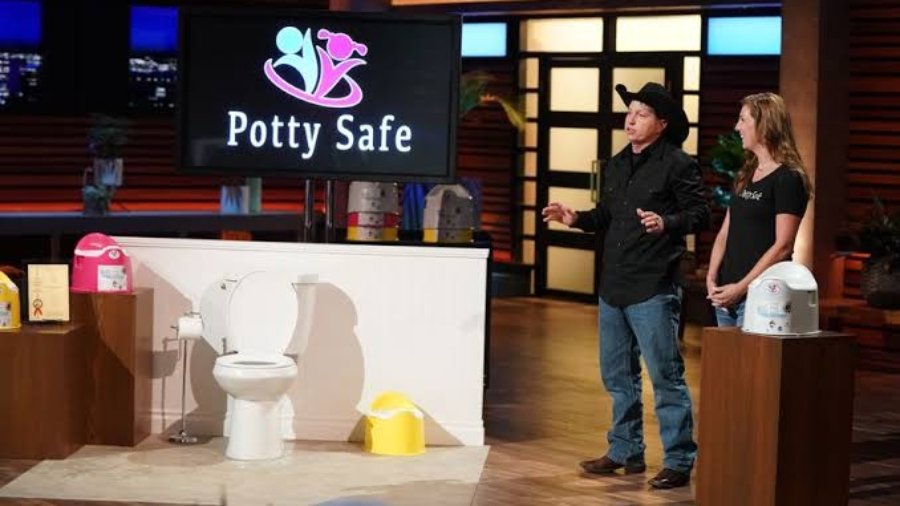
Potty Safe landed an on-air deal with Lori Greiner on Shark Tank, hit over $1 million in annual sales, and then quietly disappeared from every major retailer. It’s one of those stories that looks like a clean success from the outside but gets more complicated when you look at the full timeline.
This article breaks down who built the product, what happened during the pitch, how the business performed post-air, and why it appears to have shut down — along with a few honest takeaways for entrepreneurs watching from the sidelines.
Who Created Potty Safe and What Problem It Solved
Potty Safe was created by Colt and Stacy Hall, a couple based in rural Missouri. The product itself is simple: a toddler training potty with a childproof latch that stops kids from removing the waste bowl and spilling the contents.
The idea came directly from Stacy’s experience with toilet training. Standard potties have a removable bowl — which means curious toddlers can (and do) pull it out and make a mess. The Halls designed a locking mechanism to prevent exactly that.
That one feature was the entire product story. There was no complicated technology, no subscription model, no app. Just a mechanical latch that competitors hadn’t built into their potties. It was a real problem with a straightforward fix, which turned out to be a strong foundation for a pitch.
The Shark Tank Pitch — Season 11, Episode 22
The Halls appeared on Season 11, Episode 22 of Shark Tank asking for $50,000 in exchange for 15% equity. Their pitch included a live demonstration — showing how easy it is for a toddler to pull out a standard potty bowl and spill the contents. It was a clear, visual way to sell the problem before selling the solution.
The Sharks had questions about market size, how defensible the product was against competitors, and whether the sales numbers justified the ask. One by one, they passed.
Then came the moment the episode is known for. Lori Greiner initially went out — and then called the founders back. She made a counter-offer: $50,000 for 20% equity, plus a royalty of $2 per unit until $250,000 was recouped, then $1 per unit in perpetuity.
That royalty structure is worth paying attention to. On a low-cost consumer product like a toddler potty, per-unit royalties cut into margins on every single unit sold — not just early on, but permanently. For a product with a retail price point in the $30–$50 range, a $1 ongoing royalty is a meaningful ongoing cost. It’s the kind of deal term that looks manageable on TV but can create real pressure at scale.
The founders accepted the on-air deal. But what happened next is the more instructive part of the story.
What Actually Happened After the Episode Aired
The Lori Greiner deal never closed. According to multiple sources that track Shark Tank outcomes, the agreement fell apart during post-show due diligence. This is not unusual — a significant share of on-air deals don’t survive the due diligence process. But it meant Potty Safe moved forward without Lori’s backing, resources, or retail relationships.
Despite that, the business did well in the short term. After the episode aired, Potty Safe reportedly saw a nearly 500% increase in sales. The company grew to over $1 million in annual sales and eventually reached approximately $5 million in lifetime revenue across its years in operation.
Distribution expanded to Walmart.com, Amazon, and Buy Buy Baby — a solid retail footprint for a single-product brand run by a family in rural Missouri.
One thing worth clarifying: $5 million in lifetime sales is revenue, not profit, and certainly not the founders’ personal net worth. Some Shark Tank recap coverage blurs this distinction, but revenue and take-home income are very different numbers — especially for a physical product business with manufacturing, shipping, and retail costs built in.
Why Potty Safe Appears to Be Out of Business
As of the most recent available reporting, Potty Safe appears to have shut down. The product is no longer listed on Amazon, Walmart, or Buy Buy Baby. The official website displays a security error. The Instagram account went inactive in late 2023, and the X (formerly Twitter) account stopped posting in 2021. SharkTankCompanies lists the brand as no longer operating.
No official statement from the founders has been widely reported. The business appears to have wound down quietly rather than through any public announcement.
What likely contributed — and these are contextual factors, not confirmed causes — comes down to a few common challenges for this type of product:
- No finalized Shark backing. Lori’s network and retail expertise could have opened doors that a family-run operation in rural Missouri would struggle to open independently. Without that support, scaling beyond the initial TV bump becomes harder.
- Limited repeat purchase potential. A toddler potty is a one-time buy. Parents purchase it, use it for a year or two, and move on. That means the business constantly needs new customers — there’s no base of repeat buyers to sustain revenue over time.
- Single-SKU hardware brand challenges. Running a physical product business with one item is expensive relative to what you sell. Marketing costs, inventory, logistics, and retail fees all apply to that single product. Expanding the line or raising prices are the obvious solutions, but neither is simple.
Again, none of these have been confirmed as the specific reasons by the founders. But they’re consistent with the patterns that trip up many similar brands after the initial Shark Tank surge fades.
What Entrepreneurs Can Take Away From This
The Potty Safe story is genuinely useful as a case study — not because the business failed spectacularly, but because it followed a pattern that many product-based businesses follow.
The post-Shark Tank bump is real, but it doesn’t last
A 500% sales increase after an episode airs is meaningful. But that spike is driven by millions of viewers watching a single episode. Once the episode stops airing in rotation, the traffic slows. Businesses that use that window to build durable distribution, brand awareness, and a customer base tend to survive. Those that don’t often see sales return toward pre-show levels.
On-air deals are not signed deals
Potty Safe is a good reminder that what happens on camera and what gets finalized in a contract are two different things. Due diligence exists for a reason — investors look at financials, supply chain, IP, and a range of factors that don’t make it into a 10-minute TV pitch. Founders should always have a plan for both scenarios: the deal closes, and the deal doesn’t.
Read royalty structures carefully
Lori’s proposed deal included a per-unit royalty in perpetuity. For a high-margin, high-volume product, that structure might work. For a low-cost consumer hardware product with competitive retail pricing, it creates a permanent drag on unit economics. Before accepting any royalty arrangement, model it against your actual cost structure at different volume levels.
Single-product, single-stage businesses face a ceiling
Potty Safe solved one specific problem for one specific stage of a child’s development. That’s a strength in terms of clarity and focus — but it’s a limitation in terms of lifetime customer value. Building a brand around a narrow product category is possible, but it usually requires either expanding the product line or accepting that growth will plateau once the addressable market is saturated.
For more business breakdowns and startup case studies, Daily Business Zone covers the kind of real-world examples that go beyond the highlight reel.
Final Thoughts
Potty Safe did a lot right. The founders identified a real problem, built a product that solved it clearly, and delivered a compelling pitch. They hit $1 million in annual sales and $5 million in total revenue without the Shark deal they thought they were getting.
But the business appears to be gone now — no website, no retail listings, no social media activity. What’s left is a useful record of what the Shark Tank effect actually looks like in practice: a real boost, a real business, and a real set of challenges that the show’s edit doesn’t fully capture.
The Halls built something from scratch and took it to national retail. That’s worth acknowledging. What comes after the cameras turn off is just a harder problem than any pitch can prepare you for.
Read Also: