
Most people finish a paint job, seal the can back up, and shove it in the garage. A year later, they open it to find rust flakes, dried chunks, or paint that’s completely unusable. Jason and Carson Grill, a father and son from Cincinnati, Ohio, built a business around fixing exactly that problem.
Their product, the Touch Up Cup, went from a practical household idea to a nationally distributed brand after appearing on Shark Tank Season 12. Here’s a clear look at how the pitch went, what the deal looked like, and where the business stands now.
The Problem Behind the Product
Traditional metal paint cans rust. They’re hard to reseal properly, and the paint inside can form a thick skin or dry out between uses. For small touch-ups — a scuffed wall, a paint chip near the door frame — cracking open a gallon can feel like more work than it’s worth.
Jason and Carson’s solution is a 13 fl oz reusable container with a patented airtight seal. The design keeps paint smooth, rust-free, and odor-free between uses. The company claims paint stays fresh for up to 10 years — that’s a manufacturer claim based on the airtight design, not an independently verified figure over a full decade, so treat it accordingly.
The container also includes a built-in blending mechanism to remix paint before reuse, along with measurement markings on the side. The concept is simple: pour leftover paint in after a job, seal it, and have it ready for future touch-ups without buying a new batch or dealing with a spoiled can.
The Shark Tank Pitch — Season 12
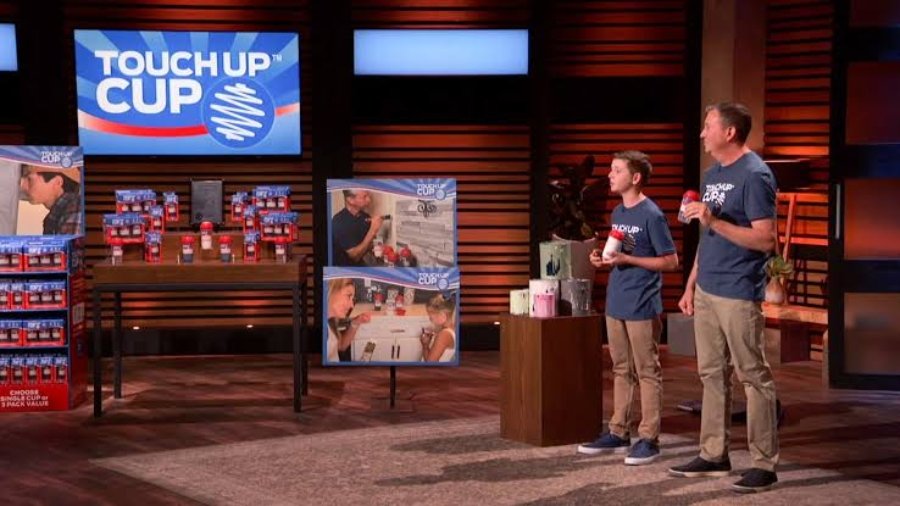
Jason and Carson appeared on Season 12 of Shark Tank. Carson was a teenager at the time, which gave the pitch a strong youth-entrepreneur angle that clearly resonated in the room.
Their original ask was $150,000 for 10% equity. During the pitch, they demonstrated the difference between paint stored in a traditional can versus paint stored in a Touch Up Cup — a straightforward visual that made the problem and solution easy to see.
They also walked through the economics: a landed cost of around $0.90 per cup, wholesale pricing of roughly $1.89 for a single cup or $4.25 for a three-pack, and a retail price range of $3.99 to $4.99. Those margins are solid for a consumer product, and the Sharks clearly noticed.
After negotiation, Jason and Carson accepted a deal from Blake Mycoskie, the founder of TOMS Shoes. The final terms: $200,000 for 25% equity. That’s more money than they asked for, but also a larger equity stake. For a young brand still building distribution, landing a well-known investor with consumer product experience was likely worth the trade-off.
Sales Growth and Business Performance After the Show
The episode airing triggered the usual Shark Tank effect — a surge in website traffic and orders in the days that followed. That’s common for products featured on the show, but sustaining it requires more than TV exposure.
According to SharkTankBlog, as of mid-2021, Touch Up Cup was on track to top $2 million in revenue for the year. HouseDigest later reported $1 million in sales for 2021 and projected over $3 million in 2022, though that 2022 figure should be treated as a projection rather than confirmed annual revenue.
The company also received an update segment in Season 13, Episode 1317, which confirmed continued growth. That kind of follow-up feature on the show is typically reserved for businesses that have made real progress since their original appearance.
Blake Mycoskie’s investment helped the founders refine operations and pursue national retail distribution. His specific day-to-day involvement in the business isn’t well-documented, so it’s fair to say he brought capital and connections without overstating his ongoing role.
Where Touch Up Cup Products Are Sold Today
The brand has built out a solid mix of direct and retail distribution. You can buy Touch Up Cup products through several channels:
- The brand’s own website — direct-to-consumer with full product catalog
- Walmart — broad national retail reach
- Lowe’s — a natural fit given the home improvement audience
- Meijer and Theisen’s — regional retail presence
- Amazon — listed as “As Seen On Shark Tank,” available in multiple configurations including 6-packs
Their social media presence stays active with painting tips, promotions, and customer testimonials, which suggests the marketing engine is still running. That kind of consistent content is often what keeps a Shark Tank product from fading after the initial buzz.
Retailer availability can change, so if you’re trying to find the product locally, it’s worth checking the brand’s website or calling ahead to confirm current shelf placement.
How the Product Line Expanded Beyond the Original Cup
Touch Up Cup started as a single product. It’s no longer that. The company has expanded into a broader range of painting and home products, including:
- Touch Up Cup containers in various pack sizes
- Paint tarps, brush sets, rollers, and roller covers
- A roller cleaner product called the Roller Saver
- Kitchen-focused storage containers and a grease storage bag
The kitchen and grease storage products are a bit outside the core paint niche, but the overall direction makes sense. Rather than staying a one-product company, they’re positioning Touch Up Cup as a DIY and home accessories brand — which gives them more shelf real estate, more SKUs to pitch to retailers, and more reasons for customers to come back.
This kind of line extension is a common growth move for consumer product companies after an initial product gains traction. It’s not guaranteed to work, but it reduces the risk of depending entirely on one item.
What Carson Grill Is Up to Now
Carson, who was the teenage co-founder during the Shark Tank pitch, is also involved with OCD Detailing, an automotive detailing business in Cincinnati. Whether Touch Up Cup remains his primary focus is unclear — HouseDigest notes that directly. It’s possible he’s running both ventures in parallel or has shifted more attention toward the detailing business.
That ambiguity doesn’t change the company’s standing. Touch Up Cup products are still available, the retail partnerships appear intact, and the brand continues to operate. But it’s worth noting for anyone following the founders’ individual paths.
Business Lessons Worth Taking from This Story
There are a few practical takeaways here for entrepreneurs watching this kind of trajectory.
A simple product idea can scale if the pain point is real
Touch Up Cup isn’t technically complicated. It’s a well-sealed plastic container with a smart design. The business was built on identifying a genuine everyday frustration and solving it cleanly. That’s often enough.
Margins matter when you pitch investors
A landed cost of $0.90 and a retail price of $3.99–$4.99 gives the product room to work across wholesale, retail, and direct-to-consumer channels. When Jason and Carson put those numbers on the table, it made the business model legible. Investors want to see that the math works at scale.
TV exposure is a starting point, not a finish line
The Shark Tank effect is real, but short-lived on its own. The brands that keep growing after the show are the ones that use the momentum to lock in retail partnerships, build operations, and expand the product line. Touch Up Cup did that.
The story is part of the business
A father-son team, a teenage co-founder, a relatable household problem — that narrative made the pitch memorable. It’s also what drove media coverage and consumer interest after the episode aired. For entrepreneurs, that’s a reminder that who you are and why you built it matters alongside the product itself.
For more business case studies and practical advice on entrepreneurship and growth, visit Daily Business Zone.
Final Thoughts
Touch Up Cup is a straightforward example of a Shark Tank success story that held up after the cameras stopped rolling. The founders identified a real problem, built a practical product, landed a credible investor, and used that foundation to get into major retail chains.
The revenue figures from 2021 and the projected growth into 2022 suggest the business gained real traction — not just a bump from TV. The expanded product line shows they’re thinking about long-term brand building, not just riding one product’s momentum.
Whether you’re a homeowner looking for a smarter way to store leftover paint, or an entrepreneur studying how consumer product companies grow after Shark Tank, the Touch Up Cup story is worth paying attention to.
Read Also: