
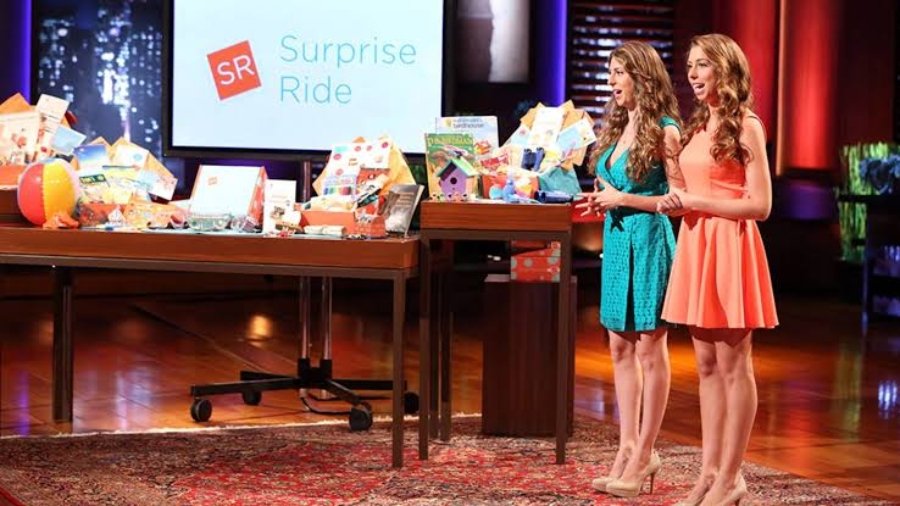
Most companies that walk off the Shark Tank stage without a deal quietly disappear. Surprise Ride did the opposite. The sisters behind the brand left without an investment on the show, then landed a Shark anyway — and eventually sold the company to an established toy business. That arc is worth understanding, whether you’re a founder, an investor, or just someone curious about what actually happens after the cameras stop rolling.
This article covers everything: the original pitch, why no deal happened on the show, how Kevin O’Leary got involved later, how sales grew, and what the Fat Brain Toys acquisition means for the brand’s story.
What Surprise Ride Was and How It Worked
Surprise Ride was a children’s subscription box company founded by sisters Donna and Rosy Khalife. Each month, subscribers received a themed box filled with curated, hands-on educational activities for kids.
The key word here is “curated.” This wasn’t a box of random toys. Each box was built around a specific theme designed to encourage kids to actually engage with what they received — think activities that required doing something, not just playing with something pre-built.
That positioning mattered. The subscription box space was crowded, and Surprise Ride carved out space by leaning into educational value rather than novelty. It was a meaningful distinction in a market where most competitors were focused on volume and variety over depth.
The Original Shark Tank Pitch
Donna and Rosy appeared on Shark Tank during Season 5. They asked for $110,000 in exchange for 10% equity in the business. No deal was made during the episode.
That’s worth framing correctly. Not getting a deal on Shark Tank doesn’t automatically mean the pitch was a failure. The show has a specific format, specific Sharks with specific investment criteria, and a time constraint that doesn’t always favor every business. Some companies walk away without a deal simply because the fit wasn’t right in that moment.
For Surprise Ride, the appearance still did something real: it put the brand in front of a national audience. That kind of visibility has a measurable effect on traffic, subscriptions, and overall public awareness — even when no money changes hands on the show itself.
How Kevin O’Leary Invested After the Show
This is the part that often gets confused in coverage of Surprise Ride, so it’s worth being precise. Kevin O’Leary did not invest during the original Shark Tank episode. The investment came later, through Beyond the Tank, the follow-up series that revisited companies after their original appearances.
According to Business Insider, O’Leary invested in Surprise Ride outside the original pitch — making the company the first to land a Shark investment after missing out on the initial show. That’s an unusual outcome, and it says something about how the brand held up after its TV moment.
The practical lesson here is straightforward: the Shark Tank appearance opened a door. But the actual capital came through a separate follow-up relationship. The show was the starting point, not the finish line.
This distinction also matters for founders who think about Shark Tank purely as a funding vehicle. In Surprise Ride’s case, the more durable value of the appearance wasn’t the pitch itself — it was the continued visibility that kept the company on O’Leary’s radar.
Sales Growth After Shark Tank
The numbers tell a clear story about what TV exposure combined with real investment can do for a small startup.
According to reporting from Looper, Surprise Ride hit $500,000 in sales by the end of 2014 following the Shark Tank appearance. By the end of 2015, that figure had grown to $1 million. With Kevin O’Leary’s involvement, the company reportedly reached over $3 million in sales within roughly two years of the partnership.
These are reported figures, not guarantees, and growth trajectories vary widely depending on market conditions, execution, and a dozen other factors. But the direction is clear: the combination of public visibility and actual investment helped the company scale from a subscription startup into something that looked like a real acquisition target.
It’s also worth noting what drove that early growth. The Shark Tank bump gave Surprise Ride a traffic and awareness spike that a small company would normally spend years building. The challenge for any business after that kind of exposure is converting short-term attention into long-term subscribers — and by the numbers, Surprise Ride largely managed to do that.
The Fat Brain Toys Acquisition in 2018
In November 2018, Surprise Ride was acquired by Fat Brain Toys, an established toy and games company. The acquisition price was not disclosed, and there’s no reason to speculate on the number.
Fat Brain Toys is known for quality educational toys and games, which made Surprise Ride a logical fit for their portfolio. The brand’s emphasis on curated, learning-focused activities aligned well with what Fat Brain was already building. This wasn’t a random acquisition — it was a strategic one.
Surprise Ride announced the move through its own social media channels, describing the transition as joining the Fat Brain Toys family. PR Newswire covered the official announcement, which specifically identified Surprise Ride as a Shark Tank company — a detail that shows how much the show’s brand association still carried weight years after the original appearance.
The acquisition is the clearest signal that Surprise Ride became a genuine business, not just a TV moment. Getting acquired by an established company in your industry is a real exit. It means another business looked at your customer base, your brand, and your product and decided it was worth paying for.
For entrepreneurs tracking startup outcomes, that distinction matters. A lot of businesses get a PR boost from Shark Tank. Fewer build something durable enough to become an acquisition target. Surprise Ride did both.
Is Surprise Ride Still in Business?
After the acquisition, Surprise Ride continued operating under the Fat Brain Toys umbrella. Some later reporting describes the brand as still active, with product listings available and the subscription model continuing in some form.
The most concrete, well-supported milestone in the company’s timeline is the 2018 acquisition. What the brand looks like in operational terms today — subscription volume, product lineup, pricing — is harder to confirm with precision. If you’re a current or potential customer, checking directly with Fat Brain Toys or Surprise Ride’s official channels is the most reliable way to get up-to-date details.
For business purposes, what matters is that the brand survived well past its Shark Tank moment, scaled to a reported $3 million in sales, and was eventually absorbed by a company with the infrastructure to support it. That’s a solid arc for a small startup that didn’t even close a deal on the show itself.
What the Surprise Ride Story Actually Teaches
If you strip away the TV angle, the Surprise Ride story is about a few practical things that apply to any small business.
- Visibility without capital is still useful. The Shark Tank appearance gave Surprise Ride something most startups never get: national exposure at scale. Even without a deal, that mattered.
- The pitch isn’t always the deal. O’Leary invested later, not during the episode. Sometimes relationships develop after the formal process, not during it.
- Subscription models need retention, not just acquisition. Hitting $1 million in sales means customers were sticking around, not just signing up after a TV appearance and canceling.
- A good acquisition is a real outcome. Not every startup should aim to be a unicorn. Getting acquired by an established company in your category, at a reasonable multiple, is a legitimate exit strategy.
For more analysis on real business outcomes and startup stories, Daily Business Zone covers the kind of practical business updates that go beyond the headlines.
Final Thoughts
Surprise Ride’s Shark Tank story is a good example of how the show’s real value isn’t always the investment — it’s the platform. Donna and Rosy Khalife left Season 5 without a deal, but they used the exposure to grow their business, eventually attracted Kevin O’Leary through a follow-up series, scaled past $3 million in reported sales, and sold the company to an established toy brand in 2018.
That’s not a story about failing on Shark Tank. It’s a story about what happens when a team builds something real enough to keep moving forward — with or without the cameras on.
Read Also: