
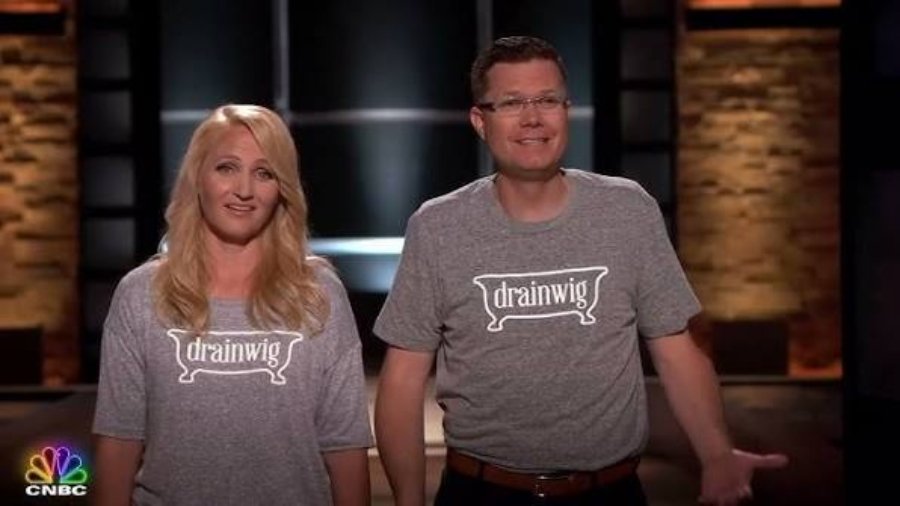
Drainwig walked into the Shark Tank having already done $14.2 million in retail sales. Yet the founders had taken home only a fraction of that. That gap between headline revenue and actual founder earnings is what makes this story worth paying attention to — not just as a product success, but as a business lesson.
This article covers the origin of the product, what happened on Shark Tank, how the Kevin O’Leary deal played out, where the company stands today, and what entrepreneurs can take from the Drainwig model.
How a Piece of Dental Floss Led to a Consumer Product
In 2013, Jennifer and Gifford Briggs were at home when dental floss accidentally fell into their shower drain. When Gifford opened the drain to retrieve it, he found the floss wrapped around a dense ball of tangled hair. That moment sparked the idea for Drainwig.
The product itself is straightforward. It’s a disposable chain with small rubber whiskers that sits inside a drain. As water flows past, the whiskers catch hair passively. After two to four months, you pull the chain out, throw it away, and replace it. No chemicals, no drain snake, no touching a wet clump of hair.
Drainwig was positioned as a cleaner, simpler alternative to liquid drain cleaners and manual snaking tools. From the beginning, the Briggs family ran it as a tight family operation — their five daughters helped assemble products and attended trade shows alongside their parents.
The Shark Tank Pitch — Season 9, Episode 6 (2017)
The Briggs family appeared on Season 9, Episode 6 of Shark Tank in 2017. They came in asking for $300,000 in exchange for 5% equity — putting their valuation at $6 million.
The number that caught everyone’s attention was $14.2 million in retail sales already on the books at the time of the pitch. That’s not a startup with a prototype. That’s an established product with real market traction.
The unit economics were solid too. Manufacturing cost ran approximately $1.20 per unit, while a double pack retailed at $9.99. That’s a strong gross margin for a consumer goods product. Drainwig had also already appeared in infomercials and had shelf space in big-box retail stores before the show aired.
Multiple sharks were interested. Lori Greiner and Daymond John both made offers. Kevin O’Leary closed the televised deal at $300,000 for 15% equity — a higher equity stake than the founders originally wanted, but it came with O’Leary’s network and credibility attached.
It’s worth noting that for Drainwig, Shark Tank wasn’t a launch pad. The business already existed and was selling at scale. The show functioned more as a credibility amplifier — and a path to a more structured partnership.
The Kevin O’Leary Deal and the Licensing Arrangement
The deal with Kevin O’Leary did close after the show, which isn’t always the case with televised Shark Tank agreements. According to Drainwig’s official “Our Story” page, the partnership led to a five-year licensing agreement.
Licensing arrangements like this have a real trade-off. The founders gained broader distribution reach without carrying the full operational burden of scaling the business themselves. But licensing also means giving up margin. The licensor or distributor takes a significant cut, and the inventor receives a royalty — usually a small percentage of sales.
A Reddit discussion in the r/sharktank community noted that after $14.2 million in retail sales through their infomercial partnership, the founders reportedly received around $800,000. That figure is anecdotal and not a verified financial fact, but it illustrates a pattern that shows up often in consumer product licensing: gross sales can look impressive while the inventor’s actual take-home is a much smaller slice.
Think of it like an author who licenses a book to a major publisher. The publisher handles printing, distribution, and marketing. The total sales might be substantial — but the author’s royalty might be 10 to 15 percent of net receipts, not gross sales. The Drainwig situation appears to follow similar logic.
This doesn’t mean licensing is a bad strategy. It often lets founders scale faster than they could on their own. But the economics need to be understood clearly before signing — especially when the distributor captures most of the margin.
Where Drainwig Stands Today
Drainwig is still in business. SharkTankBlog reported approximately $1 million in annual revenue as of April 2023, and SharkTankCompanies confirms the brand remains active as of 2026.
The product is currently available on Amazon, on Drainwig’s own website, and through at least some online retailers including The Container Store. Specific big-box retail presence is less clear at this point — some sources describe broad retail distribution while others are more cautious. It’s fair to say distribution has shifted somewhat toward online channels over time.
Social media activity has been limited since around 2019 to 2020, with Facebook largely inactive and minimal Instagram posting. But low social media activity doesn’t automatically signal a struggling business. The product targets a practical need — hair clogs — not a trend-driven market. Repeat buyers don’t need a social media nudge to reorder.
The product line has also evolved. The original flower-shaped holder has been joined by seashell and seahorse designs, along with a version built to sit hidden inside a bathtub drain. The core function hasn’t changed, but the aesthetic options and placement flexibility have expanded.
The Family Reclaiming the Business
One of the more interesting parts of the Drainwig story is what comes after the licensing period. According to their official “Our Story” page, with the five-year licensing agreement behind them, Jennifer and Gifford — along with their now-grown daughters — are positioned to reclaim and manage the business as a family again.
The daughters who once assembled products as kids are now adults focused on rebranding and bringing fresh ideas to the company. That’s a second chapter that doesn’t get talked about enough in entrepreneur circles: what happens when you take your business back after licensing, and how you rebuild momentum under family ownership again.
It also highlights a longer business arc than most Shark Tank stories. This isn’t a flash-in-the-pan product that rode TV exposure and then faded. It’s a family business that’s been through infomercials, licensing deals, a nationally televised pitch, and is now entering what looks like a third phase of operation.
What Entrepreneurs Can Take From the Drainwig Story
There are a few concrete lessons here that apply well beyond shower drains.
Gross sales don’t tell the whole story. $14.2 million in retail revenue sounds like a major success — and it is, in terms of market validation. But if the founders walked away with around $800K (per that Reddit discussion), that’s a very different picture. Always understand what the net looks like before signing a licensing or distribution deal.
Shark Tank works differently for established products. Drainwig didn’t need the show to launch. It needed legitimacy and a structured deal. That’s a different use of the platform than a startup with no sales and a rough prototype. If you already have traction, Shark Tank can help you level up — but your leverage at the table is different.
Licensing is a tool, not a shortcut. The Briggs family used licensing to grow faster than they could have managed independently. That worked. But it came with a cost in terms of margin and control. Know what you’re trading before you trade it.
Simple problems make durable products. Hair clogs aren’t going away. Drainwig doesn’t rely on a trend or a technology cycle. That kind of evergreen utility gives a product staying power that trend-based items rarely have.
For more practical breakdowns of real business stories, visit Daily Business Zone.
Final Thoughts
Drainwig is a good example of what a consumer product business actually looks like — not the cleaned-up pitch version, but the real thing. There are licensing trade-offs, margin gaps, distribution shifts, and family dynamics all mixed in together.
The founders built something real, took it to a national stage, navigated a licensing deal, and are now in the process of bringing it back under family control. That’s a full business story, not just a Shark Tank clip.
The product works, the company is still running, and the lessons it offers are practical ones. That’s more than most pitches can say a few years after the cameras stop rolling.
Read Also: